Pick a Bookmaker That Pays, Not One That Restricts
A live ranking of the international sportsbooks that consistently take large bets, settle withdrawals on time, and treat profitable customers as customers.
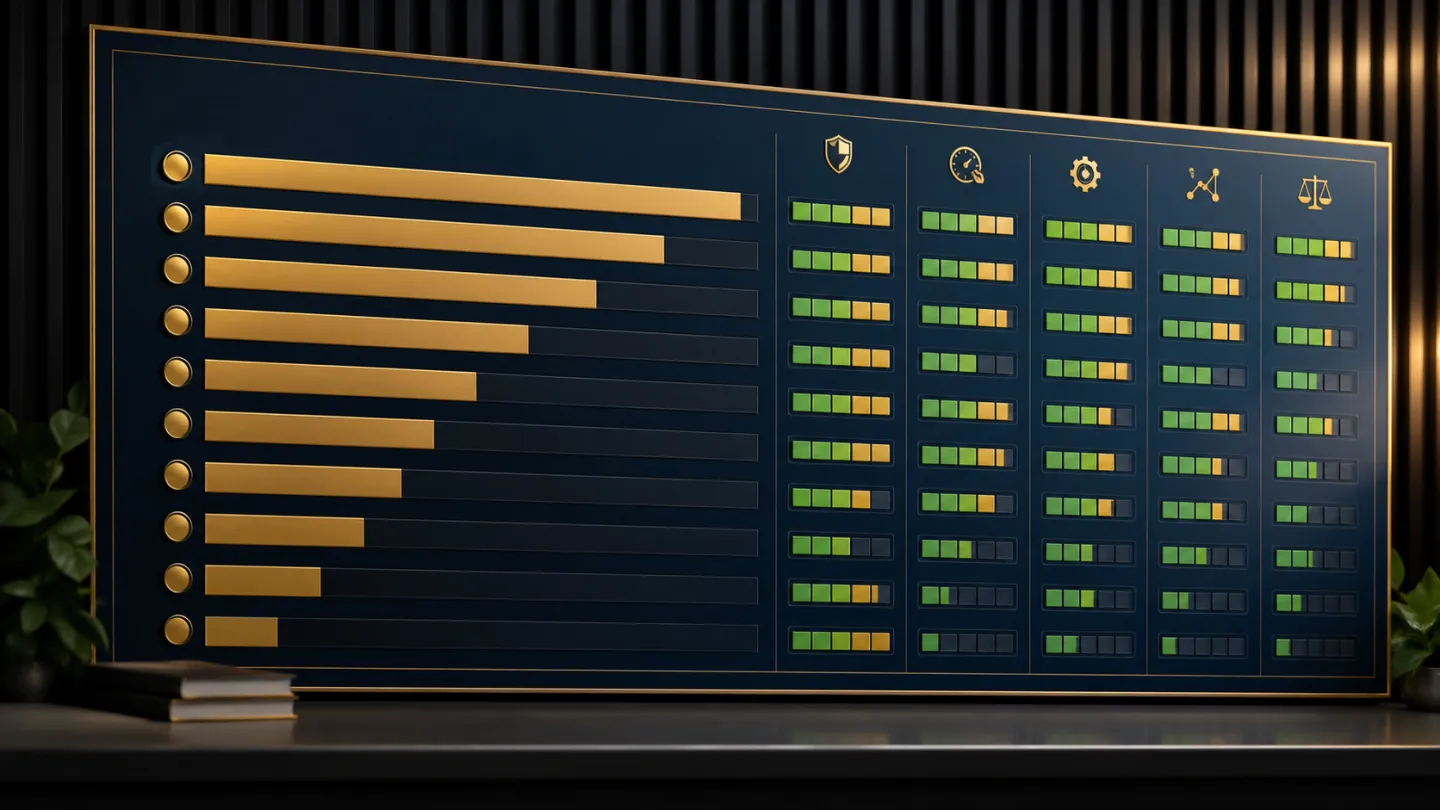
This page explains the criteria we use to evaluate offshore bookmakers, presents the editorially ranked top operators, and walks through the comparison matrix that separates pay-the-winner books from the rest. We update the ranking quarterly based on observed payout behaviour, limit policy, and reader-reported incidents.
The Five Criteria That Actually Matter
Every ranking on the open web claims to evaluate "trust", "reputation", or "user experience". Those are weasel words. A ranking aimed at serious bettors has to be measurable, and the five criteria below are the ones that have predictive value once an account moves past the recreational phase.
Maximum stakes on liquid markets
The honest stake limit is what the book accepts on a flagship event (Premier League 1X2, ATP 1000 final, Champions League knock-out) without manual approval. We capture that number directly from the bet slip, not from the marketing page. Operators that quote a six-figure maximum on the homepage but apply a 500-unit factor at the slip level are flagged accordingly. A genuine no-limit posture is rare and is the single most predictive signal of operator class.
Payout speed across rails
Time-to-funds is measured from the moment the withdrawal is requested to the moment the money clears the destination account. Crypto rails are tracked in minutes, e-wallets in hours, bank wires in business days. We test withdrawals at three sizes (small, mid, large) on every operator we review, because most books pay small withdrawals quickly and only show their true colour at scale.
Market depth and minor-league coverage
A sharp book prices Asian Handicap at quarter-goal increments on the third division of a top-five country, lists corners and cards markets on the same fixture, and offers in-play prices that move on the play, not on a thirty-second delay. Depth is what makes value betting possible. Without it, you are forced into the same two or three top markets where the public concentrates and where edges are thinnest.
KYC strictness and friction
Verification policy is a proxy for the operator's risk appetite. Books that delay KYC until the first significant withdrawal are typically more friendly to anonymous play but slower at the moment you need cash. Books that demand full verification at signup are faster on withdrawal but harder to keep low-profile. Neither is wrong, both are operational choices the bettor needs to align with their own posture. Our KYC primer covers the document side in detail.
Treatment of winning accounts
This is the criterion every recreational ranking ignores and the only one a professional cares about. We track stake-factoring patterns, account-closure incidents, and the lag between a positive ROI streak and the first noticeable restriction. Operators that maintain limits even after a clear winning record sit at the top of the table, regardless of their cosmetic shortcomings on UX or promotions.
Source : offshorebettingzone.com
Comparison Matrix
The matrix below summarises each operator on a 1 to 5 scale across the four most actionable criteria. The scores are editorial, derived from internal testing and from a year of reader-reported incidents. The table is the canonical data; the radar chart underneath is a visual aid generated from the same numbers.
| Criterion | Freshbet | Betlabel | MaxiBet | Vave | 20bet |
|---|---|---|---|---|---|
| Stakes accepted | 5 | 4 | 4 | 4 | 3 |
| Payout speed | 5 | 5 | 4 | 4 | 4 |
| Market depth | 4 | 4 | 4 | 3 | 4 |
| Treatment of winners | 4 | 4 | 4 | 4 | 3 |
Deep Dive: What "Offshore Infrastructure" Means Operationally
Licensing layer
A licence is a contract between the operator and a regulator. It dictates capital requirements, anti-money-laundering posture, segregation of player funds, and the dispute-resolution path if a customer claim escalates. Curacao licences come in two flavours, master and sub-licence, with very different oversight. Anjouan is the newest entrant and is filling the gap left by recent Curacao reform. Kahnawake remains an under-rated venue with active supervision, particularly for poker-adjacent operators. Malta and the Isle of Man sit at the strict end and are expensive to maintain, which filters operators by capitalisation. None of these are interchangeable. We cover the regulatory comparison in the licensing landscape page.
Solvency and float
Bookmakers hold customer funds as a mix of working capital, regulator-mandated reserves, and a pool of "in-play" balances rotating through bets. The healthier the book, the larger the share of segregated funds and the smaller the share of customer money commingled with operating capital. Solvency stress shows up not as a press release but as withdrawal delays, especially during sequences of correlated losses (a bad weekend on the Premier League, for example). Sustained delays are the canary, not customer-service tone.
Liquidity and pricing engine
The price you see is the output of a pricing engine that is either built in-house, licensed from a B2B supplier, or sourced through a broker network. Sharp Asian books typically run their own engine, which is why their prices move first. Mid-tier offshore operators copy a feed from a sharp book and apply a margin overlay. Recreational books drift further away from the sharp price, especially in late, low-liquidity windows where the operator has to fall back on its own assessment. Knowing which engine drives the price you face is a useful proxy for how reliable the line is.
Withdrawal pipeline
The pipeline starts at a customer-side wallet (crypto, e-wallet, IBAN) and runs through the operator's payment processor stack. Every operator has a primary processor and one or two backups; switching processors is what causes the occasional "withdrawal method temporarily unavailable" message. A multi-rail operator absorbs that fragility, a single-rail operator cannot. For high-volume bettors, payment-stack diversity is a survival trait.
Worked Scenario: A 1,000-Unit Withdrawal
Assume a 1,000-unit withdrawal request on a Friday afternoon, denominated in EUR equivalent.
- Crypto, BTC. Verified account, withdrawal initiated 16:00 UTC. On-chain confirmation typically within 30 minutes; funds spendable in 1 to 6 confirmations depending on the receiving wallet. Real-world median observed across our partners: 22 minutes.
- International e-wallet. Submission accepted instantly, processed in the next batch (often within 2 to 6 hours). Funds available in the e-wallet by Friday evening, transferable to bank by Monday.
- SEPA wire. Submission accepted Friday, processed Monday morning, value date typically Tuesday or Wednesday for the larger banks. First-time withdrawals trigger compliance review, adding 24 to 48 hours.
- SWIFT wire (non-EUR). 2 to 5 business days plus correspondent-bank fees. Use only for amounts that justify the friction.
The operational implication is that the choice of payment rail dictates how often you can recycle bankroll between books. A bettor running multiple operators on crypto can rebalance daily; one running on bank wires has a weekly cadence at best. The same handicapping edge applied at different rebalancing frequencies produces materially different annual returns through compounding.
Pro Tips for Account Longevity
- Verify early, before you need to withdraw. Submit documents during the calm period after signup, not in the middle of a winning streak when emotions and timing pressure interact badly.
- Keep deposits and withdrawals symmetric. If you deposited via crypto, withdraw via crypto. Mixed rails trigger compliance reviews far more often than single-rail flows.
- Stake in round but realistic numbers. A book whose typical recreational stake is 50 EUR will treat a 50,000 EUR ticket as a flag. Build up over weeks, not days, on a new account.
- Spread exposure across at least three operators. Counterparty risk is real. A bettor concentrated on a single book is one operational incident away from a frozen bankroll.
- Document your activity. Keep a spreadsheet of every bet, the closing line, the result, and the operator. When a book asks for "source of funds" or evidence of trading patterns, you want the data ready, not reconstructed under deadline.
- Use a broker for high-volume play. Once stakes exceed what a single sharp book will tolerate, the natural next step is a broker network. We cover the mechanics in our broker primer.
Risks and Red Flags
Not all offshore books are equivalent. Some are reliable counterparties, some are weakly capitalised, a few are outright fraudulent. The checklist below summarises the warning signs we have observed across years of reader complaints and operator monitoring.
- "Bonus rollover" terms that retroactively void winnings if the bettor's pattern looks professional.
- Withdrawal limits dramatically below stated maximums (for example, daily caps of 1,000 EUR on an account that accepts 10,000 EUR bets).
- Sudden requests for additional documentation only at withdrawal time, despite KYC having been completed at signup.
- Customer-service silence on technical issues, replaced by templated responses.
- Recurring "system maintenance" windows that coincide with the European weekend football slate.
- Anonymous or freshly registered domains running aggressive paid advertising in markets where domestic regulation is recent and weakly enforced.
None of these signs is conclusive in isolation. In combination, they describe a book the bettor should avoid or run only with capped exposure. A more comprehensive treatment of due diligence and exit-scam patterns lives on our risk management page.
How Often the Ranking Changes
The ranking is updated quarterly. Updates can move an operator up (consistent payouts, expanded limits, new market depth) or down (incidents reported by readers, slower payouts under load, regression on KYC posture). We do not paywall updates and we do not rotate the list to fit promotional cycles. The single biggest reason a book moves down is a verified pattern of withdrawal slowdown at scale.
Frequently Asked Questions
How do you rank offshore bookmakers?
Each operator is scored on five quantitative dimensions: maximum stakes accepted on top markets, payout speed across crypto and fiat rails, market depth on Asian Handicap and minor leagues, KYC strictness, and how the book treats winning accounts after consistent profitable activity. Editorial weighting favours pay-out reliability and tolerance of winners.
What is the difference between a sharp book and a recreational book?
A sharp book prices closer to the true probability, accepts large stakes from professional accounts, and uses order flow as a signal rather than as a customer to manage out. A recreational book maximises margin per bet, restricts winners, and depends on adverse selection. The two operate on opposite revenue models.
Are crypto-only bookmakers safer than fiat-only operators?
Neither rail is intrinsically safer. Crypto reduces banking friction and chargeback exposure for the operator, which often translates into more permissive limits and faster withdrawals. Fiat-only books are constrained by the payment networks they rely on, which can slow large transfers. The deciding factor is the operator, not the rail.
What withdrawal speed is realistic for a professional account?
On crypto rails, a verified account should see funds in under one hour, often under fifteen minutes. International e-wallets typically settle in 24 hours. Bank wires for large amounts take two to five business days, longer for first-time withdrawals where compliance reviews kick in.
Does an offshore licence guarantee anything?
A licence is a baseline filter, not a guarantee. Curacao, Anjouan, Kahnawake, MGA, and Isle of Man have very different supervisory intensity. The operator behind the licence matters more than the badge. Track record on payouts is the only metric that has predictive value.